Do hourly teams need an applicant tracking system?
An applicant tracking system (ATS) keeps every job, applicant and hiring step in one place. Most were built for office hiring. This guide covers where one fits hourly hiring, where it falls short, and what to ask before you buy.
The basics
What an applicant tracking system does
For a team that hires a few office roles a year through a recruiter, this is the job: one tidy record per candidate.

Posts your jobs
To your careers page and to job boards.
Collects applications
In one list instead of an inbox.
Moves applicants through stages
From applied to screened, interviewed, offered and hired.
Keeps notes and history
So a manager can see what happened before them.
Stores records
That you may need later for audits or disputes.
Reports
On where applicants come from and how long hiring takes.
Where hourly hiring is different
Hourly hiring is high volume, the applicant is on a phone, and speed decides who you get.
- Most clicks never become an application. The median apply rate across job ads was 5.19% of clicks in 2025 (Appcast, 2026 Recruitment Marketing Benchmark Report).
- Long forms put people off. 49% of US workers say most application processes are too long and complicated (Indeed, 2024 Workforce Insights Report).
- The phone is the computer. 34% of US adults in households earning under $30K use a smartphone as their only internet access (Pew Research Center).
- Good applicants have options. Recent hires held a median of 2 job offers (ZipRecruiter, New Hire Survey Q2 2026). The employer who answers first usually wins.
- Reminders get people to show up. In healthcare, reminders cut missed appointments by 25% (BMJ Open, 21 trials).
- The hiring manager is on the floor, not at a desk. A store or shift manager hires between customers, often from a phone.
An ATS can still hold the record. The trouble is usually at the front door: the apply step, the first reply, and getting the candidate to the interview.
What to look for
What hourly hiring needs
The front door matters more than the filing cabinet.
Apply from a phone in minutes
No account, no password and no new app.
Screening questions instead of a resume
Availability, shifts, start date, work authorization. Many hourly applicants have no resume to send.
An answer the same day
Ideally the same hour, while the candidate is still looking.
Interviews that get confirmed
The manager picks a time, the candidate confirms, and reminders go out on their own.
One entry point per location and job
A sign in the window, a QR code or a job ad link, so applicants land in the right list.
The candidate's language
Especially where your crew speaks Spanish or Portuguese.
Decide
When you need a full ATS
If most of these are true, a full applicant tracking system earns its keep.
Salaried or office roles
With several interview rounds and offer approvals.
Several recruiters
Sharing candidates, with detailed permissions and audit trails.
Record-keeping duties
That need a system of record, for example as a federal contractor.
Your HR system expects it
Hires have to come from one specific tool.
Decide
When a phone-first apply and screening tool is enough
If these sound like you, the front door is the problem to solve first.
Most openings are hourly
Crew, cashiers, drivers, warehouse, care staff.
Managers do the hiring
Store or site managers, not a recruiting team.
Several locations
Each one runs its own hiring.
Applicants drop off
They start and don't finish, or never show up to the interview.
Running both
Plenty of teams keep the ATS they have and put a faster front door in front of it. Applicants apply by chat, the screening and scheduling happen there, and hires flow into the system of record. Before you choose this route, check that the tool can export or connect: an open API, a CSV export, or both.
Questions to ask before you buy
- Can a candidate apply from a phone without creating an account? How long does it take?
- Can they apply by text message or WhatsApp, or only through a web form?
- Does it ask screening questions, or does it need a resume?
- How fast does a candidate get a reply, at 9 p.m. or on a Sunday?
- How does a manager schedule an interview, and does the candidate confirm it?
- Does it send interview reminders without anyone pressing a button?
- Can each location and job have its own code, link or QR sign?
- Which languages can candidates use?
- How is candidate consent handled, for texting and for data?
- How is it priced: per user, per job, per location or per hire? What happens when you add a location?
- Can you get your data out: export, API, or both?
- Can you try it with a real job before you sign?
Where TalentAxis fits
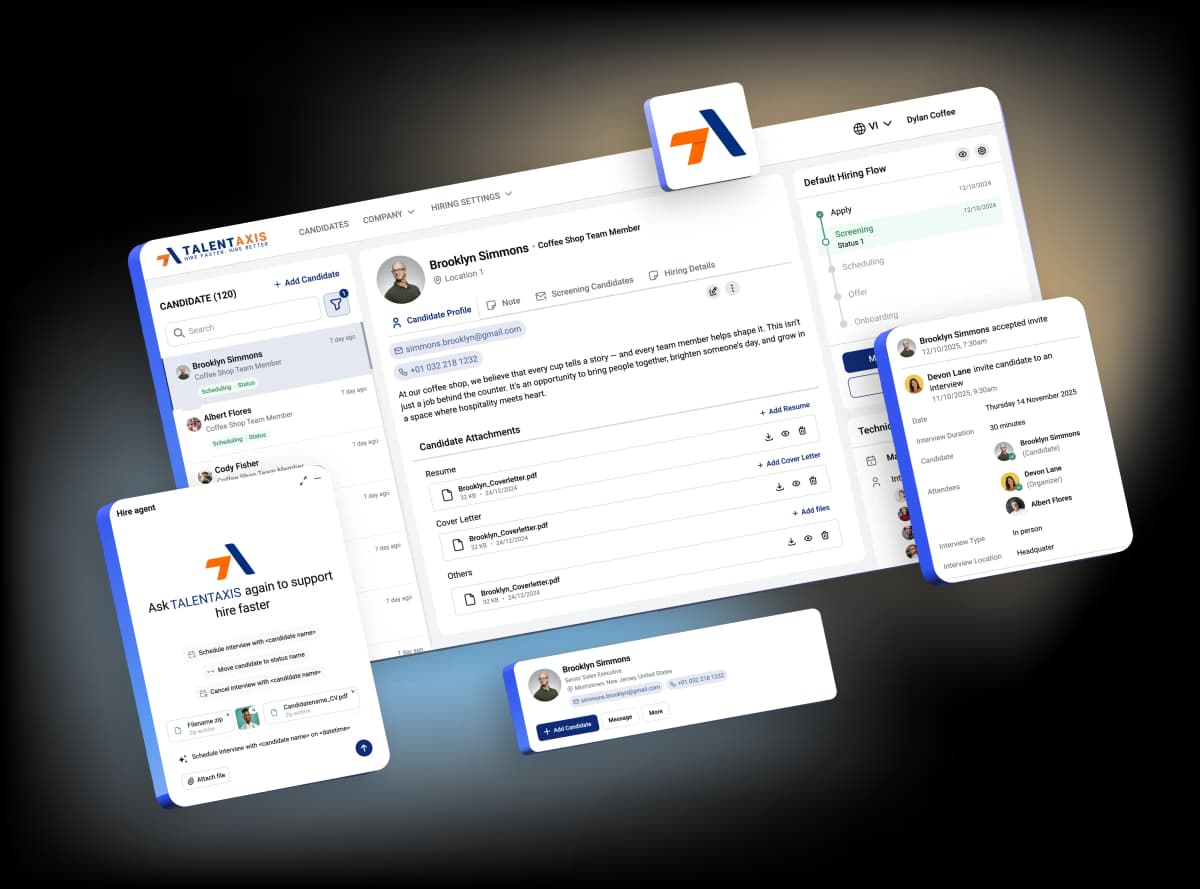
TalentAxis is a high-volume hiring platform for hourly teams. Candidates apply by text or WhatsApp, with no new app, from a sign in the window, a QR code or a job ad link. The chat asks your screening questions, AI scores each applicant from the answers, the recruiter picks an interview time and the candidate confirms with one tap, and reminders go out on their own. It runs standalone, with an open API. See how Text to Apply works.
Frequently asked questions
What is an applicant tracking system?
Does a small business need an ATS?
Do hourly applicants need a resume?
Is it legal to text job applicants?
What does hiring software cost?
Does TalentAxis replace an ATS?
Try it with one of your jobs
Set up a job, print its sign and see candidates apply in a chat.